Noia Galicia - some bad points (Amended 2014)
Its very easy to extol the virtues of anything you like, but it is also important to acknowledge faults as well and Noia has (did have) some features which could be remedied, replaced or better still removed altogether. The biggest single drawback to Noia is in fact the feature that should be its strongest visual selling point, its "ria" or bay.
Noia's bay
Noia has the perennial problem of being situated at the point where two estuarial rivers meet the sea. Whilst this location places Noia in a coastal
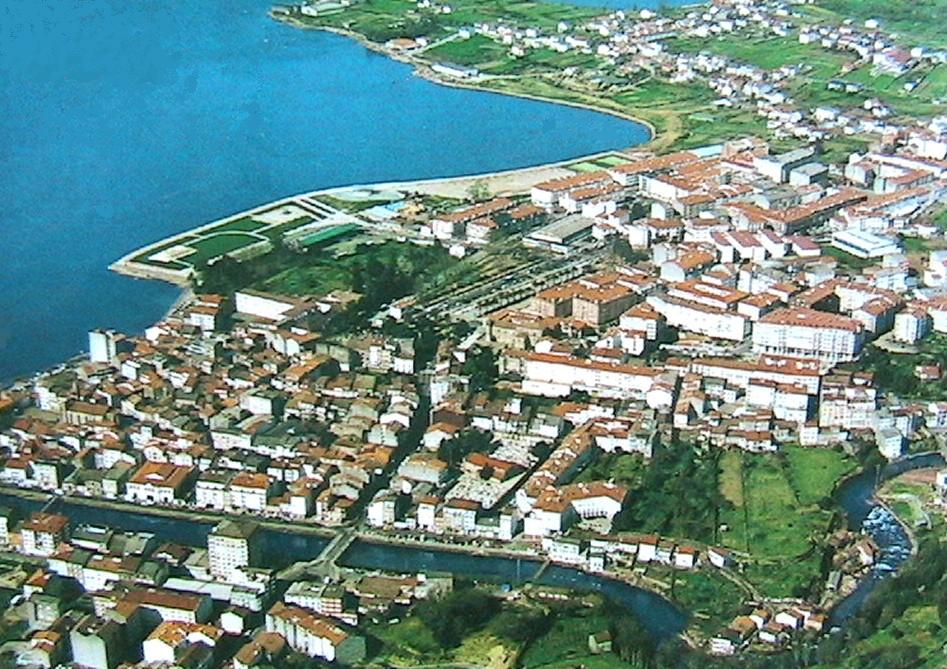 bay, it also places Noia at the very spot where silt traveling down river hits the incoming current of the ocean and comes to a dead halt. The result is that whilst Noia's bay superficially appears attractive when the tide is in, on closer inspection (when the tide is out) you realize the bay is not full of clean clear water, but silt washed down from the mountains.
Below left, a post card view of Noia and the bay when the tide is in. One of the rivers is clearly visible in the lower third of the photo (postcard).
Despite an anouncement in December 2008, that a plan had been put in place (with finance) to clean up the ria around Noia (it was due to start in either 2009 or 2010) nothing transpired. It would seem that it was all part of a political campaign and once the party in question was elected the money - if there ever was any - went elsewhere. As of 2014, the ria around the town is worse than ever.
Building maintenance
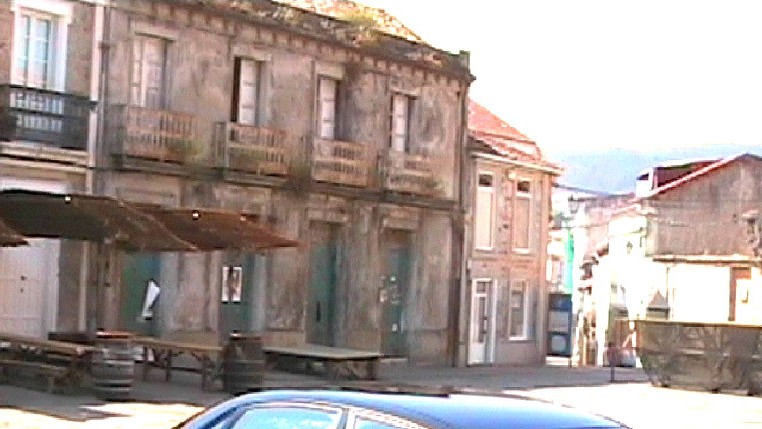
Galicia as a whole suffers from the problem of having many poorly maintained buildings often next to, or even connected to, some highly appealing ones. Whilst Noia is certainly no worse than anywhere else in Galicia, it does have its fair share of "falling down" old ruins in prominent positions.
I should perhaps temper this observation by pointing out that Noia's council are making a significant effort to contact owners, offer grants and generally try to "put right" any buildings in a poor condition and prominent postion.
An update
Unlike the issues with the ria silting up, the renovation of decrepit properties in the town is being addressed.
Since I originally wrote this page, literally dozens of old buildings in the town have been renovated and are now being put to a practical use. The two photos (above right and below left) show the same buildings in the same historic Tapal plaza. As can be seen from the second more recent picture, this square is now restored to its original stunning appearance.
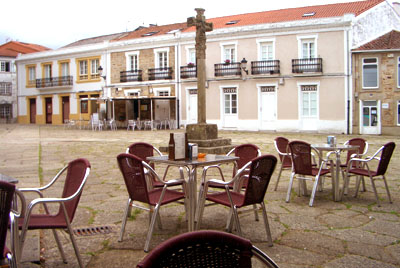 Plans are also a foot to do something with the old casino (and the building next to it). Both had been left to decay (with the owners being uncontactable), but both have now been purchased by the council. The building above, and indeed the entire plaza in which it is situated, are now in great shape and make a superb feature in Noia's medieval quarter.
Whilst Noia has plenty of tapas bars and informal style eateries, it does lack formal style restaurants for that special night out. There is no shortage of good dining in the town, but if you like table cloths, formal service, or a traditional and romantic ambience, your choices are somewhat limited. Even so, there are some great places in which to eat and spend an evening. This page, tapas, will tell you about some of the places in town where you can eat.
As an amendment to the comment above, I have had an e-mail about a restaurant in the medieval district which is apparently very good. It is located under the arches on the left as you head for "San Martino" church and is just before, and on the opposite side of the street to the "la Parra" tapas bar mentioned else where. I believe the street is called "Canton" and the building holding the restaurant is the "Pazo Dacosta". We have had tapas there many times, but did not realise that there was a formal eatery there as well. Many thanks to Andrew Hilton.
The newer parts of Noia, GaliciaThe original village of Noia has been expanded upon over the years and some of the newer additions that surround the old district are not so appealing, especially those adjacent to the river that feeds the bay.
One of the main protagonists was an ugly old building that was predominantly visible as you approached Noia from the southern coastal road which is very scenic. You enter this side of town by traversing a river and crossing a bridge. This ugly building has now been replaced with something "slightly" better, but still very out of keeping with the rest of the townscape. The result is that, as you approach Noya you will be faced with some shabby and ugly buildings. It is at this moment that you might think that you have made a big mistake and that Noia is a destination to knock off the list. Rest assured, the interesting parts of Noia are behind this less than attractive facade and you will be pleasantly surprised once you are in Noia itself. Alternatively, if you approach Noia from the Muros side of the bay, your first view of the town center will be its large open square and you should be suitably impressed.
Further changes to Noia in 2014 and running to 2015 are firstly, a new bridge that bypasses Noya. This bridge began in 2013 and is now complete (summer 2014). It enables traffic travelling from Santiago de Compostela to swing out into the ria and around Noia. You can also walk across it. The bridge starts at the beach and town of Testal. Views on its aesthetic appeal or varied.
Secondly,The street and pavements adjacent to the town's theatre and indoor market are being landscaped and renewed. This work was still taking place in summer 2014, but already it was starting to look good. Additionally, the theatre itslef is also going to be upgraded. All good news for Noya.
Noia In perspective
- If you want to visit Noia, remember that it is still a living working Galician coastal town with many assets countered by a small number of forgivable faults. Noia does not pretend to be something it is not, nor does it make any attempt to hide or disguise its distant or recent history. If you visit Noia you will see a town living in the present, but strongly connected to the past and trying, like all historic places, to balance the two.
The intention of this page remains to showcase Noia, but not to the exclusion of objectivity. I believe that anyone who has had a sufficient level of interest in Noia to read this far would not regret a visit, be it a day trip from Santiago, or a holiday using Noia as its base.
If you want a bird's eye view of Noya, take a look at this Noya mirrador page which shows a view looking down at the town and its ria.
Thanks to our friends Jo and Pepe for making us aware that this page's content required updating (last updated 2014).